Every question counts. ✊
🦠
Did you know?
You have more bacterial cells than human cells — ~38 trillion bacteria vs ~30 trillion human cells.
Did you know?
You have more bacterial cells than human cells — ~38 trillion bacteria vs ~30 trillion human cells.
Which of the following graphs represents the variation of resistivity with temperature for copper?
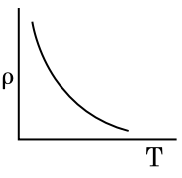
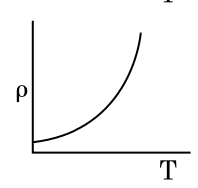
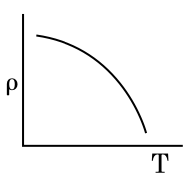
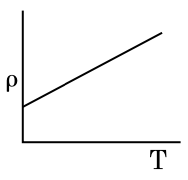
To determine which graph represents the variation of resistivity with temperature for copper, we need to understand the behavior of metals.For metals like copper, resistivity increases with temperature. This is because as temperature rises,the lattice vibrations increase, causing more collisions for the electrons and thus increasing resistivity.The relationship is approximately linear over a moderate temperature range and can be expressed as:where is the resistivity at a reference temperature, and is the temperature coefficient of resistivity.Analyzing the options:• Option 1 shows a decreasing curve, which is typical for semiconductors, not metals.• Option 2 shows an increasing curve, which is consistent with the behavior of metals.• Option 3 shows a decreasing curve, similar to Option 1, and is incorrect for metals.• Option 4 shows a linear increase, which is also consistent with metals, but the curve in Option 2 is more typical.Therefore, the correct graph representing the variation of resistivity with temperature for copper is Option 2.
More practice, more score
Use hints to get start solving
Ask any question, get instant answers
Get detailed step by step solutions
Read while solving
Improve every day