Every question counts. ✊
💧
Did you know?
Water is the only substance found naturally in all three states on Earth's surface.
Did you know?
Water is the only substance found naturally in all three states on Earth's surface.
A spherical ball is dropped in a long column of a highly viscous liquid. The curve in the graph shown, which represents the speed of the ball as a function of time is:
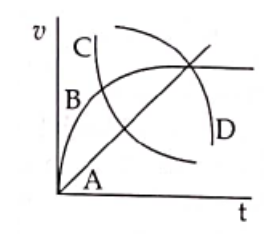
A
B
C
D
To solve this problem, we need to understand the motion of a spherical ball in a viscous liquid.When the ball is dropped, it initially accelerates due to gravity. However, as it moves through the liquid,it experiences a viscous drag force that increases with speed. Eventually, the ball reaches terminal velocity,where the gravitational force is balanced by the drag force, and the acceleration becomes zero.The speed-time graph for this motion should show:• An initial increase in speed as the ball accelerates.• A gradual leveling off as the ball approaches terminal velocity.Analyzing the given graph options:• Curve A: Shows a linear increase, which is not correct as it doesn't level off.• Curve B: Shows an initial increase followed by a leveling off, which matches the expected behavior.• Curve C: Shows a decrease in speed, which is incorrect.• Curve D: Shows a constant speed, which is incorrect for the initial phase.Therefore, the correct graph is represented by Curve B, which corresponds to Option 2.
More practice, more score
Use hints to get start solving
Ask any question, get instant answers
Get detailed step by step solutions
Read while solving
Improve every day