Every question counts. ✊
⚗️
Did you know?
One mole contains 6.022 × 10²³ particles — if a mole of seconds passed, it'd be 19 quadrillion years.
Did you know?
One mole contains 6.022 × 10²³ particles — if a mole of seconds passed, it'd be 19 quadrillion years.
The graph of a particle performing simple harmonic motion is shown in the figure. The acceleration of the particle at is:
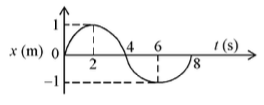
m/s
m/s
m/s
m/s
To solve this problem, we need to determine the acceleration of the particle at from the given graph.The equation for simple harmonic motion (SHM) is:Where:• is the amplitude.• is the angular frequency.• is the phase constant.From the graph:• The amplitude m.• The period s (since the graph completes one cycle in 8 s).The angular frequency is given by: rad/s.The acceleration in SHM is given by:At from the graph, m.Substitute the values into the acceleration equation: m/sTherefore, the acceleration of the particle at is m/sThis corresponds to Option 4.
More practice, more score
Use hints to get start solving
Ask any question, get instant answers
Get detailed step by step solutions
Read while solving
Improve every day