Every question counts. ✊
⚗️
Did you know?
One mole contains 6.022 × 10²³ particles — if a mole of seconds passed, it'd be 19 quadrillion years.
Did you know?
One mole contains 6.022 × 10²³ particles — if a mole of seconds passed, it'd be 19 quadrillion years.
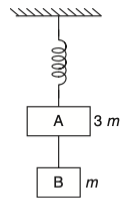
Two blocks A and B of masses and respectively, are connected by a massless and inextensible string. The whole system is suspended by a massless spring as shown in the figure. The magnitudes of acceleration of A and B immediately after the string is cut are, respectively,
g, g
To solve this problem, we need to determine the accelerations of blocks A and B immediately after the string is cut.Initially, the system is in equilibrium, so the spring force balances the gravitational force on the entire system.When the string is cut, block B is no longer supported by block A, and both blocks will experience free fall.Let's analyze each block separately:1. Block A (mass ):• After the string is cut, block A is only acted upon by gravity.• The acceleration of block A is equal to the acceleration due to gravity, .2. Block B (mass ):• Similarly, block B is also only acted upon by gravity after the string is cut.• The acceleration of block B is also .Therefore, the magnitudes of acceleration of A and B immediately after the string is cut are both .This corresponds to Option 2: .
More practice, more score
Use hints to get start solving
Ask any question, get instant answers
Get detailed step by step solutions
Read while solving
Improve every day