Every question counts. ✊
⚡
Did you know?
A bolt of lightning heats the surrounding air to ~30,000 K — five times hotter than the Sun's surface.
Did you know?
A bolt of lightning heats the surrounding air to ~30,000 K — five times hotter than the Sun's surface.
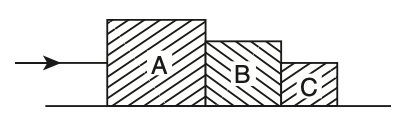
Three blocks A, B and C of masses 4, 2 and 1 kg respectively, are in contact on a frictionless surface, as shown. If a force of 14 N is applied onto the 4 kg block, then the contact force between A and B is
N
N
N
N
To solve this problem, we need to find the contact force between blocks A and B.Given:• Mass of block A kg• Mass of block B kg• Mass of block C kg• Total force applied NThe blocks are on a frictionless surface, so they will accelerate together.First, calculate the total mass of the system: kgNext, calculate the acceleration of the system using Newton's second law: m/sNow, consider the forces acting on block B. The contact force is the force exerted by block A on block B.Using Newton's second law for block B: NTherefore, the contact force between blocks A and B is N.However, since the question asks for the contact force between A and B, we need to consider the force exerted by A on B, which is the same as the force exerted by B on A due to Newton's third law.Thus, the contact force between A and B is N.This corresponds to Option 2.
More practice, more score
Use hints to get start solving
Ask any question, get instant answers
Get detailed step by step solutions
Read while solving
Improve every day