Every question counts. ✊
🌌
Did you know?
If you removed all empty space from atoms in your body, you'd compress to the size of a speck of dust.
Did you know?
If you removed all empty space from atoms in your body, you'd compress to the size of a speck of dust.
A uniform rod of length cm and mass g is balanced on a wedge placed at cm mark. A mass of kg is suspended from the rod at cm and another unknown mass is suspended from the rod at cm mark.Find the value of such that the rod is in equilibrium. m/s
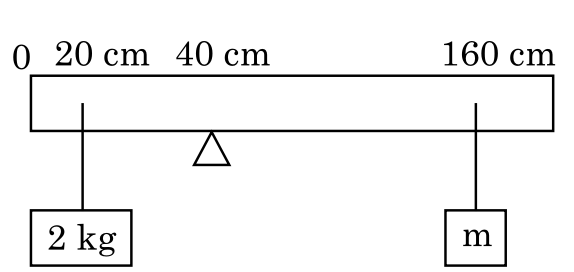
kg
kg
kg
kg
To solve this problem, we will use the principle of moments (torque) for equilibrium.Given:• Length of the rod cm• Mass of the rod g kg• Mass suspended at 20 cm kg• Unknown mass suspended at 160 cm• Wedge (pivot) is at 40 cm mark• Gravitational acceleration m/sThe rod is uniform, so its center of mass is at the midpoint, 100 cm.Let's calculate the torques about the pivot point at 40 cm.Torque due to the 2 kg mass:Distance from pivot cmTorque N cmTorque due to the rod's weight:Distance from pivot to center of mass cmTorque N cm(This torque acts in the opposite direction)Torque due to the unknown mass Distance from pivot cmTorque N cmFor equilibrium, the sum of clockwise torques must equal the sum of counterclockwise torques:Solve for kgSince mass cannot be negative, we must have made an error in direction.Re-evaluate the direction:The correct equation should be:Solve for again: kgTherefore, the value of is kg.This corresponds to Option 4.
More practice, more score
Use hints to get start solving
Ask any question, get instant answers
Get detailed step by step solutions
Read while solving
Improve every day