Every question counts. ✊
🌡️
Did you know?
Absolute zero (−273.15°C) is the coldest possible temperature — at which atoms nearly stop moving.
Did you know?
Absolute zero (−273.15°C) is the coldest possible temperature — at which atoms nearly stop moving.
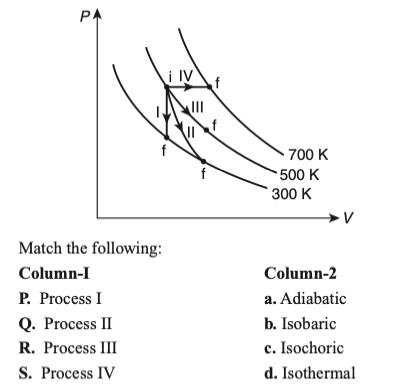
Thermodynamic processes are indicated in the following diagram: Match the following:
cadb
cdba
dbac
acdb
To solve this problem, we need to identify the type of thermodynamic process for each curve in the diagram.The processes are labeled as I, II, III, and IV. Let's analyze each:• Process I: This is a vertical line on the diagram, indicating constant volume. - This is an isochoric process.• Process II: This curve is along an isotherm (constant temperature line). - This is an isothermal process.• Process III: This is a horizontal line on the diagram, indicating constant pressure. - This is an isobaric process.• Process IV: This curve is steeper than the isotherms, indicating no heat exchange. - This is an adiabatic process.Now, match the processes with the options:Column-I:P. Process Ic. IsochoricQ. Process IId. IsothermalR. Process IIIb. IsobaricS. Process IVa. AdiabaticThis corresponds to Option 1:cdbaTherefore, the correct option is Option 1.
More practice, more score
Use hints to get start solving
Ask any question, get instant answers
Get detailed step by step solutions
Read while solving
Improve every day