Every question counts. ✊
🦠
Did you know?
You have more bacterial cells than human cells — ~38 trillion bacteria vs ~30 trillion human cells.
Did you know?
You have more bacterial cells than human cells — ~38 trillion bacteria vs ~30 trillion human cells.
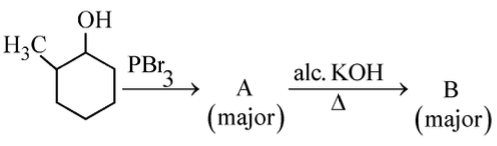
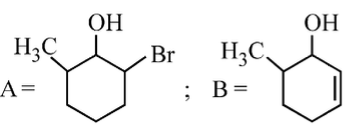
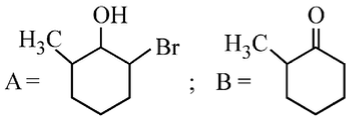
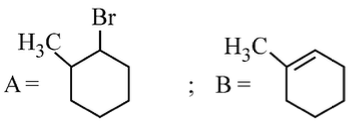
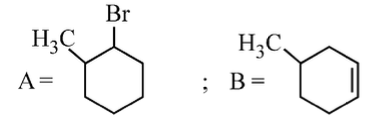
To solve this problem, we need to analyze the reaction sequence step-by-step:1. The first reaction involves the conversion of an alcohol to an alkyl bromide using • The given compound is a cyclohexanol derivative.• replaces the group with a atom.• This results in the formation of a bromo compound, which is compound A.2. The second reaction involves the elimination reaction using alcoholic KOH.• Alcoholic KOH induces dehydrohalogenation, removing to form an alkene.• The major product is the more substituted alkene due to Saytzeff's rule.Analyzing the options:• Option 1: Incorrect, as the product B is not an alkene.• Option 2: Incorrect, as the product B is a ketone, not formed in this reaction.• Option 3: Correct, as A is the bromo compound and B is the more substituted alkene.• Option 4: Incorrect, as the alkene is less substituted.Therefore, the correct option is Option 3.Compound A: 1-bromo-2-methylcyclohexaneCompound B: 3-methylcyclohexene
More practice, more score
Use hints to get start solving
Ask any question, get instant answers
Get detailed step by step solutions
Read while solving
Improve every day