Every question counts. ✊
🌌
Did you know?
If you removed all empty space from atoms in your body, you'd compress to the size of a speck of dust.
Did you know?
If you removed all empty space from atoms in your body, you'd compress to the size of a speck of dust.
Of the following, which is the product formed when cyclohexanone undergoes aldol condensation followed by heating?
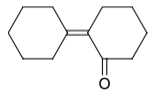
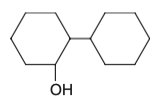
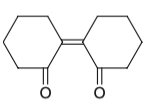
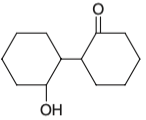
To solve this problem, we need to understand the aldol condensation of cyclohexanone.Aldol condensation involves the following steps:1. Formation of the enolate ion:• Cyclohexanone undergoes deprotonation at the alpha carbon to form an enolate ion.2. Nucleophilic attack:• The enolate ion attacks the carbonyl carbon of another cyclohexanone molecule, forming a beta-hydroxy ketone.3. Dehydration:• Upon heating, the beta-hydroxy ketone undergoes dehydration to form an alpha, beta-unsaturated ketone.Let's analyze the options:• Option 1: This structure shows a conjugated system, but it is not the correct product of cyclohexanone aldol condensation.• Option 2: This structure is a beta-hydroxy ketone, which is an intermediate, not the final product.• Option 3: This structure shows a diketone, which is incorrect.• Option 4: This structure is the correct alpha, beta-unsaturated ketone formed after dehydration.Therefore, the correct option is Option 4.
More practice, more score
Use hints to get start solving
Ask any question, get instant answers
Get detailed step by step solutions
Read while solving
Improve every day