Every question counts. ✊
🫀
Did you know?
Your heart beats ~100,000 times a day — roughly 3 billion beats in a lifetime.
Did you know?
Your heart beats ~100,000 times a day — roughly 3 billion beats in a lifetime.
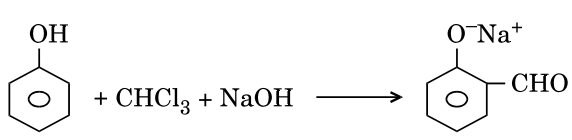
In the reaction:CHClAlClElectrophilethe electrophile involved is
Dichloromethyl anionCHCl
Formyl cationCHO
Dichloromethyl cationCHCl
DichlorocarbeneCCl
To solve this problem, we need to identify the electrophile formed in the reaction of CHCl with AlClThe reaction involves the formation of dichlorocarbene, which is a common electrophile in such reactions.Step-by-step explanation:1. Chloroform (CHCl) reacts with a strong Lewis acid like AlCl.2. The AlCl acts as a catalyst and facilitates the removal of a chloride ion from CHCl3. This results in the formation of dichlorocarbene , a neutral but highly reactive species.The reaction can be represented as:CHClAlClCClHClAlClDichlorocarbene is the electrophile involved in this reaction.Therefore, the correct answer is Option 4: Dichlorocarbene
More practice, more score
Use hints to get start solving
Ask any question, get instant answers
Get detailed step by step solutions
Read while solving
Improve every day