Every question counts. ✊
🌌
Did you know?
If you removed all empty space from atoms in your body, you'd compress to the size of a speck of dust.
Did you know?
If you removed all empty space from atoms in your body, you'd compress to the size of a speck of dust.
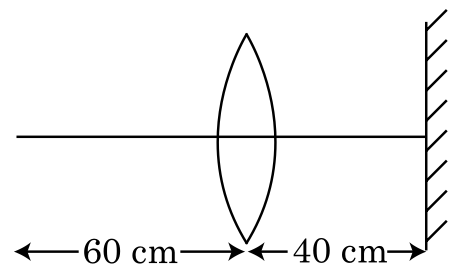
A point object is placed at a distance of cm from a convex lens of focal length cm. If a plane mirror were put perpendicular to the principal axis of the lens and at a distance of cm from it, the final image would be formed at a distance of:
cm from the lens, it would be a real image.
cm from the lens, it would be a real image.
cm from the plane mirror, it would be a virtual image.
cm from the plane mirror, it would be a virtual image.
To solve this problem, we need to consider the lens and mirror system.Given:• Object distance from the lens cm (since it is on the opposite side of the incident light).• Focal length of the lens cm.Using the lens formula:Substitute the known values:Rearrange to solve for cmThe image is formed 60 cm on the opposite side of the lens.Now, consider the plane mirror placed 40 cm from the lens.The distance of the image from the mirror cm.The mirror will form a virtual image 20 cm behind it.The final image distance from the lens cm.This image is virtual and located 20 cm from the plane mirror.Therefore, the final image is formed 20 cm from the plane mirror,and it would be a virtual image. This corresponds to Option 4.
More practice, more score
Use hints to get start solving
Ask any question, get instant answers
Get detailed step by step solutions
Read while solving
Improve every day