Every question counts. ✊
💧
Did you know?
Water is the only substance found naturally in all three states on Earth's surface.
Did you know?
Water is the only substance found naturally in all three states on Earth's surface.
The graph which shows the variation of and its kinetic energy, (where is de Broglie wavelength of a free particle) :


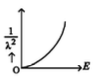

To solve this problem, we need to understand the relationship between the de Broglie wavelength and kinetic energy The de Broglie wavelength is given by:where is Planck's constant and is the momentum of the particle.For a particle with mass and velocity the momentum is:The kinetic energy of the particle is:Solving for in terms of Substitute into the momentum equation:Substitute into the de Broglie wavelength equation:Now, find This shows that is directly proportional to Therefore, the graph of versus is a straight line passing through the origin.The correct graph is Option 2.
More practice, more score
Use hints to get start solving
Ask any question, get instant answers
Get detailed step by step solutions
Read while solving
Improve every day