Every question counts. ✊
🌡️
Did you know?
Absolute zero (−273.15°C) is the coldest possible temperature — at which atoms nearly stop moving.
Did you know?
Absolute zero (−273.15°C) is the coldest possible temperature — at which atoms nearly stop moving.
A light ray enters through a right-angled prism at point P with the angle of incidence as shown in figure. It travels through the prism parallel to its base BC and emerges along the face AC. The refractive index of the prism is:
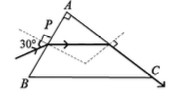
To solve this problem, we need to determine the refractive index of the prism.Given:• The angle of incidence at point is • The light ray travels parallel to the base Let's denote:• as the angle of incidence.• as the angle of refraction at point Since the light travels parallel to the base, it makes an angle of with the normal at the second face.Using Snell's Law at point Assuming the prism is in air, Simplify:Since the light travels parallel to the base, the angle of refraction at the second face is Thus, the angle of incidence at the second face is Using Snell's Law at the second face:Since the light must be internally reflected.For internal reflection, must be the critical angle:From we have:Equating the two expressions for This implies:Therefore, the refractive index of the prism is This corresponds to Option 4.
More practice, more score
Use hints to get start solving
Ask any question, get instant answers
Get detailed step by step solutions
Read while solving
Improve every day